Sunday, March 18, 2012

Vivent les Femmes

Vivent les femmes de Kolaboui! Vivent les femmes de Guinee! Vivent les femmes d'afrique! Vivent les femmes du monde!

Happy International Women's Day/Month! We celebrated in style au village. I didn't realize that March 8th was anything special until I arrived at school and my students were telling me "Bonne Fete, Madame!" which prompted me to inquire what holiday it was. I didn't realize that the women of my village were planning to do anything but on my way back from school I ran into some of the women from the women's groupement and they told me that I needed to come to our cultural center for the festivities later that night.

The festivities started with dancing to a Djembe performance. All of the women wanted to dance with me - though mostly they were trying to teach me how to dance because apparently I dance very badly (think Elaine of Seinfeld). After dancing we went outside to have a soccer tournament: women teachers VS women from the market. Tons of people showed up (including all the important authorities of our district) and cheered us on. The score was 0-0. It was awesome to see a lot of the older women wearing shorts and t-shirts. After the game we went back to our cultural center and once again danced. And afterwards we danced some more...did I mention how much we danced? I was a little self-conscious dancing in front of what seemed to be my entire community, but I got over it (my dancing was the talk of the town for a few days). Over the loudspeaker someone chanted vivent les femmes du monde and at that moment I felt really happy and connected to the women around me.
Fete des Femmes
Vivent les Jeunes Filles
Our girls soccer time finally had their first game. Let me tell you how it went….
I’ll start from the beginning. Awhile back a few coaches from the Boke/Kamsar regional girls team came to my house – they had heard that there was a girls team in my village and one of the students at my school showed them my house. They told me all about their team (mostly how good they were) and asked if we could set a date to play against each other.  We decided that their team would come to my village to have a match amical, friendly match. Organizing the date was the easy part. The hard part was getting the soccer field. One of the boys that helps me train the girls informed me that someone else had planned a boys match that day (like every other day). I had to go to this person’s house, whom, by the way, I had never met before, and had to literally beg him to let the girls play. After making more than a few sexists remarks about girls playing soccer, he told me he would think about it. Thankfully, the next day he told me that he would let us have the field, which I’m sure is not because he cared to let the girls play, but rather that he didn’t want to be known as the person who ruined the white person’s plans.
Finally, game day arrived. The girls showed up at my house early on Friday afternoon. We had to prepare sachets of water for our team and Kamsar to drink. The tension was in the air – the girls knew that Kamsar was good and they were already slightly discouraged from the start. And in fact, the game was more or less a disaster. Aside from losing 5-0, there were many problems with substitutions, girls that didn’t have shoes, etc…Tons of people showed up for the game, though, which was great because it showed that a lot of people actually support the girls. I was really worried, however, that the girls were totally and utterly discouraged and ashamed to have been beaten so badly on their home turf, in front of everyone. In a place where you have so little, dignity seems to be the one thing that you do have. I felt like I let the girls down and somehow felt that it was all my fault. My whole goal of trying to improve these girls self-confidence, was it not turned on it’s head? Would my entire village and the whole school be talking about how bad the girls soccer team was?
As it turned out, no one was saying these things except little kids who laughed and kept saying 5-0, 5-0, 5-0! But in fact, a lot of people said Du courage and even mentioned how well some of our girls played. The trainer for one of the local boys soccer teams agreed to help train the girls for future games. The boys who play on club teams are also interested in helping us and let us train and play with them now.
We also recently played in the school tournament in Boke and we beat another village 1-0. After the girls won they picked me up and danced on the field. Great, great day. Our school and village were so proud.
The girls at school getting ready to head to Boke for the big game
My most dedicated players - Mahawa and Fouleymatou
This is our fan club - riding on top of our minibus to come and support us in Boke
The girls and I before our big game. Our classement of players is on the chalkboard behind us.
In uniform


Sidenote:
Also, I found out why I'm not getting letters. I figured they were being sent to the wrong country and a recent letter that I did receive (6 months after it was sent) confirmed this:

Saturday, February 18, 2012

The Great Fruit Exchange

The season of oranges arrived in December and I have been eating oranges non-stop since, averaging about 8 oranges a day (this is not an exaggeration). By the end of most days my tongue is sore from the massive amounts of citric acid (is it a bad thing to eat too much citric acid?), though with all the vitamin C I’m sure not to get scurvy (not to be confused with scabies, which I’m sure I will get again sometime). The way people eat oranges here is by peeling them and then cutting off a piece at the top and sucking out all the juice, it’s a juice box, really. The ground is littered with the “shells” of oranges – left for the goats to eat, or better yet, used as ammunition to throw at your little brothers like snowballs (we got in a orange/snowball fight in our front yard once and it was awesome).
Fruit is also a great gift. When I was in Yorokoguea at the end of December, the woman whose house I was staying in gave me a parting gift of grapefruit. 12, in fact. I was gracious, and I do love grapefruit, but 12 is a bit much, really. This was in addition to 5 oranges that someone else picked for me. When I had arrived home I thought that I could give some grapefruits to my family and neighbors in an effort to diminish the vast quantity of fruit in my possession. How wrong was I! When I offered 1 grapefruit to my neighbor Saibatou she was so thankful that she ran into her kitchen and came out with 10 oranges for me…It seems like everywhere I go I somehow manage to pick up fruit – other teachers give me oranges, students give me oranges, random ladies give me grapefruits, my friends give me bananas…
Soon the mango season will be here. The mango trees are already flowering (very beautiful). I call the area my house is in Mangeboui, which means under the mango tree, because in fact there are 9 mango trees in our front yard. It’s a good thing I love mangoes because I will probably be eating an average of 8 a day…

Saturday, February 11, 2012

Invitation

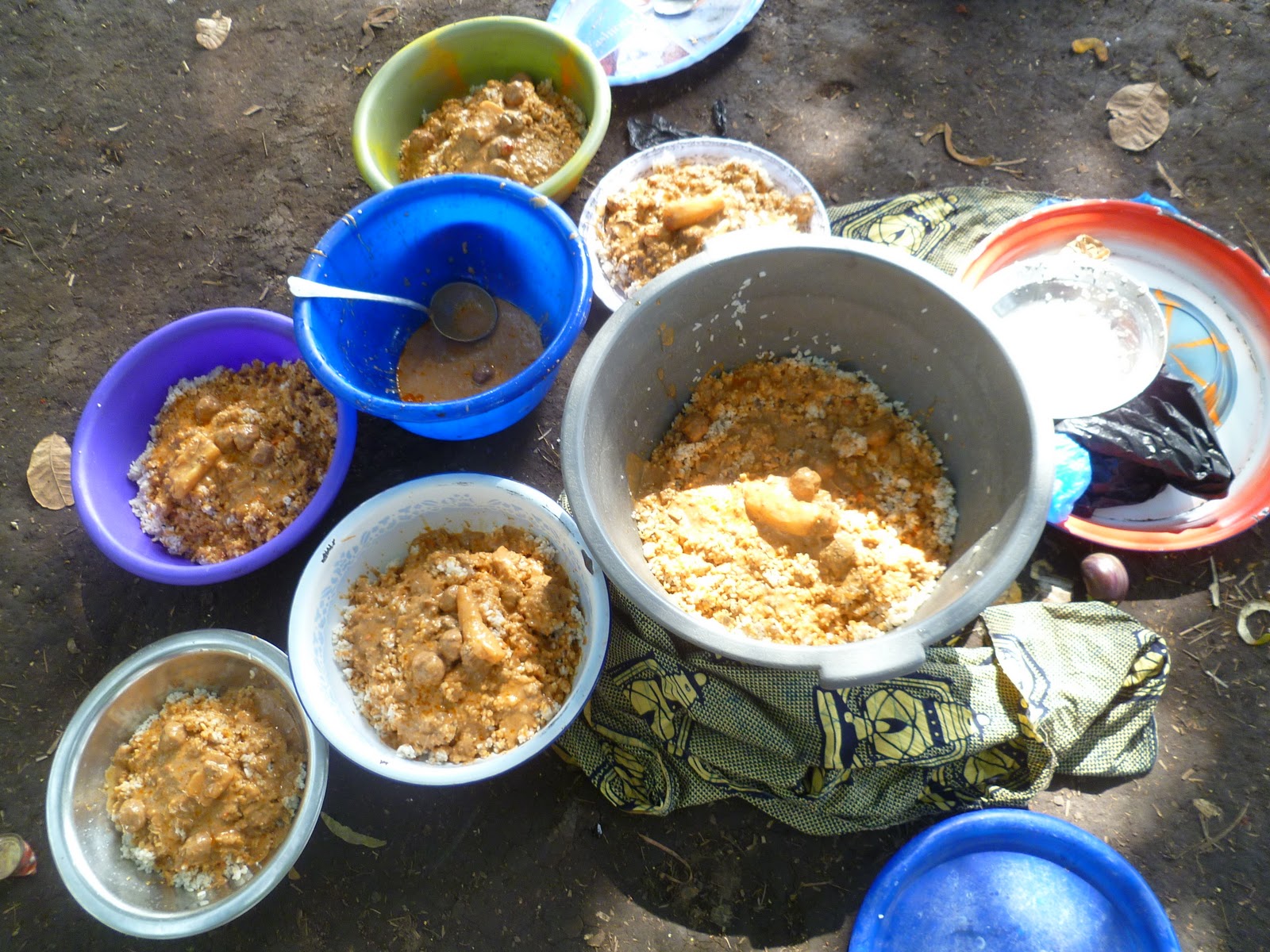
One of the most beautiful things about Guinean culture is the way people share food. 95% of meals consist of people sharing a common (giant) bowl of rice. It is polite (and necessary, really) to invite anyone in the near vicinity to come and share the rice with you. And when I say “near,” I use that term loosely, because you could be walking at one end of a soccer field and someone eating rice at their house at the other end might yell at you, Invitation!! Usually I say Ali Baraka, meaning something like “thanks to God I already ate.” However, sometimes I take people up on the offer and share a few bites of rice with them. This of course works the other way around too. I am obliged to invite everyone to share whatever I’m eating. At school I usually buy, for a cost of 1000 Guinean Francs  (15c), a bean sandwich (a piece of a baguette with beans and spicy oil) and eat it on my way home. I have to invite everyone to share my sandwich with me – this includes people riding by on bikes, in cars, ladies selling things on the side of the road, students, etc…One time I was eating rice at my house with my brothers and a neighbor came up behind me and said, “you’re not going to invite me to eat with you?” and accused me of being rude.  I tried to explain that it was hard to invite people that you didn’t see. Some people are hard-core about their invitations!
I always eat dinner with my family – usually they make a separate bowl of rice just for me, but I actually prefer eating with my little brothers and sisters (with my hands). However, whenever we eat separately I always invite them to come eat my rice and they invite me to eat theirs and then we argue whose rice is better. My little brothers and I love to argue (not real arguing, but joking) and sometimes instead of the invitation we say evitation (eviter means to avoid).
My family has a pretty tough economic situation and they more or less live day-to-day. Earlier this week there wasn’t enough money at the end of the day to buy things to make rice and sauce  so no one was going to eat dinner. I gave my family money to buy bread for everyone but there wasn’t very much bread left at the bakery, so everyone got a tiny piece of baguette for dinner. Despite, in my opinion, this being a depressing and difficult time, Issiaga, Abou, and Mohamed Aliou still joked and we all invited each other to share our pieces bread – each taking a bite out of the other person’s baguette and laughing hysterically at how silly it was. It’s amazing how they can take such hardship in stride and how they learn to be happy with what they have. The following day I mentioned something to Abou  about no one eating dinner the night before and he corrected me and said of course they ate, I had bought them bread (did I forget?)! And I said eating a tiny piece of bread is not dinner, and Abou, in his wisdom well beyond his 18  years, informed that eating a small piece of bread is a great thing, because some people don’t even have that. Perspective

Tuesday, February 7, 2012

Musique

For this post I thought I would just share a few of the most popular songs in Guinea right now. I love music; I love the way it makes people think, smile, cry, dance etc...Music seems to always be resonating the air waves of Guinea and if you can't feel the beats then you can't understand the atmosphere.

I don't really know how to go about finding more of the traditional music online to share with you. But here are a few of the songs that are very popular on Radio Kamsar right now (and that my family loves to dance to). On any given day, or any taxi ride or on the radio you're bound to hear these songs.

1. Makale - by Tiranke Sidime (Guinea). This song is often referred to as the unofficial Guinean national anthem. I doubt if I've gone one day in Guinea without hearing this song.


2. Nwa Baby -by Flavour (Nigeria). This song is not heard as often on the radio, but I dig the beats and it mostly makes me think of my little host brothers and sisters in Dubreka. They would sing the chorus of the song while dancing around our yard. I had never actually heard the song until I went to site, so now it always makes me think of them (though after seeing the music video I'm not so sure I want to associate this song with them...)


3. Désolé - by Sexion d'assaut (France). A favorite of mine and my little brothers at my site:


Thursday, February 2, 2012

Dedicate yourself

One of the toughest weeks of my Peace Corps service…yet also one of the best…

It started on Monday.  My brother Abou told me that his pen and French notebook had been stolen during class (9th grade chemistry) while he was out of class running an errand for his teacher. No students owned up to it and the teacher couldn’t do anything to get it back. DISBELIEF. I bought a new pen and notebook for Abou and he spent hours and hours recopying 3 months of notes so that he didn’t fail the “contrôle de cahier” (notebook check) in 2 days. I lent him my flashlight so he could even stay up at night to finish in time.
On Tuesday my other little brother Issiaga got kicked out of class (5th grade) because his hair was too long and needed to be cut. He didn’t have money to buy a razor so I got one for him. The elementary school is also requiring all students to  bring pictures of themselves to class to attach to the report cards - just one more thing that the students can not afford. FRUSTRATION. Tuesday night my little sister Hawa came home with her report card for 6th grade. She brought it over to me with a pen to sign where it said, “parent’s signature.” I guess being the only one invested in the education of these children my sister thought that I should sign there (I didn’t, I told her that her mom needed to do it). I also refused to sign it because she was failing all of the subjects. DISAPPOINTMENT.  She has so much working against her and she already has a 2 year old son. I told her that she needs to study harder and tried to explain the importance of education for her and also how she will be the one to pass on her knowledge to her son. Abou was sitting on the porch with us and I told him that, being the most responsible and smartest student of the family he needed to step up and be a role model and encourage the other children in our concession to keep going to school. I told him how DISCOURAGED I was about education in Guinea. As I was saying goodnight he told me, “Il faut pas être decouragé” – don’t be discouraged.

Wednesday. Feeling pretty down about education. I get to school and my 3 best students inform me that they won’t be in class because their family friend died the night before, but they didn’t want to skip class without telling me. SADNESS. I went to class wondering how students manage to make it this far with so many things going against them, when, 2 students from Terminale came into my class to make an announcement. They were asking students to donate whatever small amount of money they could to help another Terminale student whose hut had burned down and whose notebooks, uniform, and everything else had been destroyed. At this point I was just about ready to cry in class. Luckily I made it through the lesson. When I was finished with class and packing up my stuff Abou came into my classroom to ask for some chalk. He told me he wanted to do some math revision with our younger siblings. HOPE at last. I wasn’t sure if he was really going to do it, but when I got home a few hours later all of the kids were outside copying notes, 2 of my younger brothers and a neighbor were at the chalkboard on my porch doing math with Abou supervising their calculations. Tears of JOY. I have never seen of the kids in my family study outside of school. No one hardly noticed when I came home because they were all focused on what they were doing. HAPPINESS.

Thursday. My students, having sensed my discouragement the day before, came to me after class to talk with me. A group of 12th grade girls and I spent about 20 minutes talking about the issues that students face and I told them they’ve made it this far and they need to do everything they can to keep going. One of my top girls wants to be a doctor and asked if I had any resources about medicine that she could borrow. She really enjoyed when we talked about parasites and wanted to know more about them. The next day I was able to give her a few copies of info that I had relating to that. FULFILMENT.
It’s easy to get discouraged working in this environment – poverty, suffering, sickness, etc... But at the same time there are so many people that are working hard to change their lives and to change Guinea and that’s what keeps me going.
Peace Corps staff reminded me of this when confronting  these hardships (I think it comes from a Buddhist saying):
1.       Accept that there will never be an end to all suffering
2.       Dedicate yourself to the end of all suffering

This is my dedication.

Saturday, January 28, 2012

2012

Hello!
I’m back in my village from a very fun and educational time in Dubreka with the new trainees. I actually spent most of my time in Yorokoguea, a tiny village on the outskirts of Dubreka – which was relaxing and peaceful. It was neat to see what Public Health training is like – it’s very different than our educational training was. Here are some pics from Conakry/Yorokoguea:

Christmas dinner in Conakry (with Goat as the main dish)
 Some of the new trainees and Ravi, CED PCRV
 Public Health Group
 
Current agroforestry (Lacey), public health (Annie and Karen), community and economic development (Janice), and education volunteers (me).
Public Health Trainees in action!

 
The latrine in the back of the volunteer trainee house. I never thought a latrine could look so beautiful.

Went for a morning walk with Annie, PH Volunteer from Kankan, and saw some beautiful views of the mountains surrounding Dubreka.

Hi!
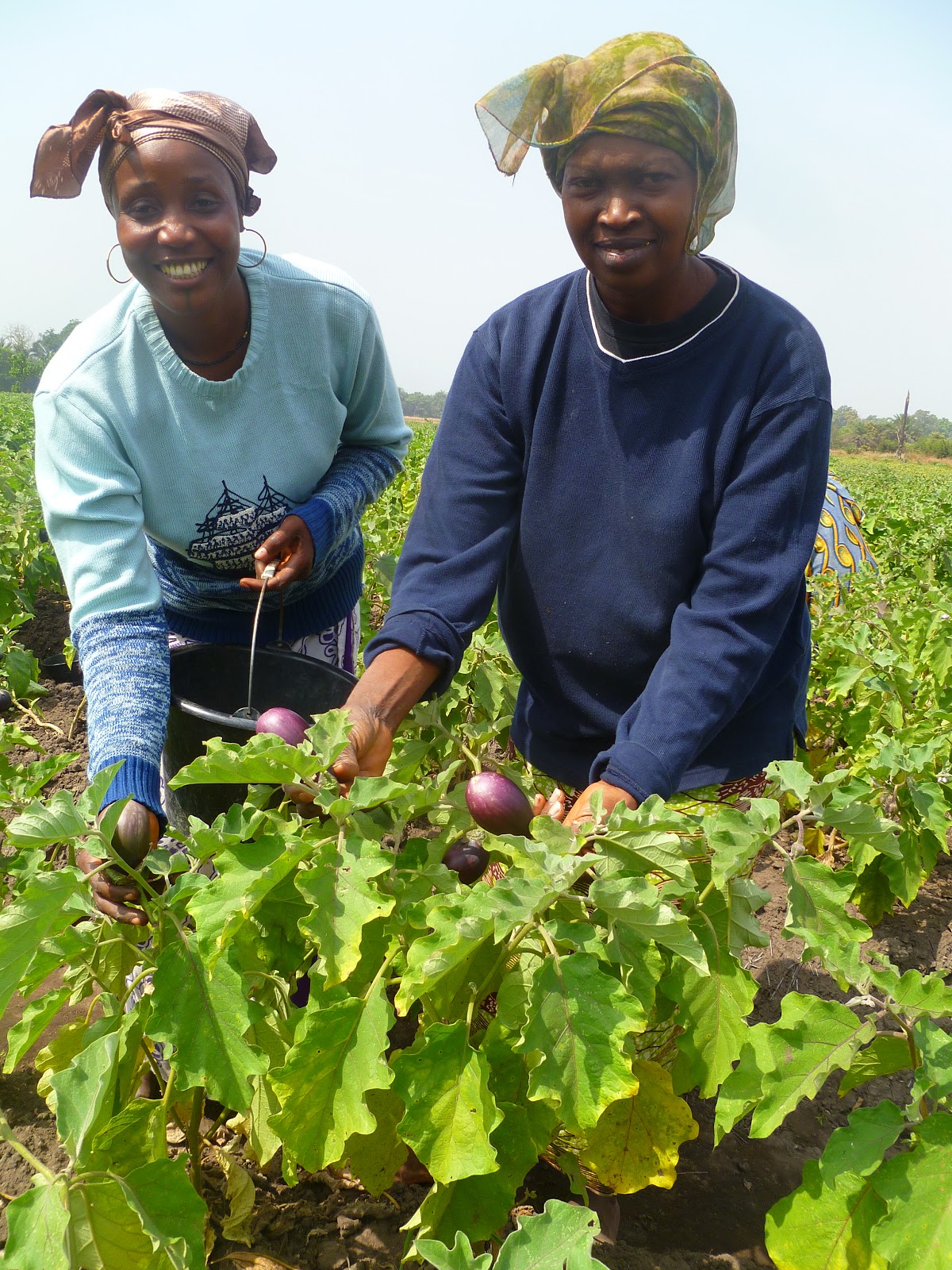
I arrived back in my village the weekend before class started up again, so I was able to spend all day Saturday in the fields with the women’s group. We’re in the eggplant harvesting season now, so I helped the women pick eggplant. There are only 2 men that help with the field work, but they have become my friends since they’re they only ones who speak French.

Noumouyah:


These are some of the women I work with.


Lunch time! Rice and peanut sauce


This is Nabi, one of the men that helps us. The other day another farmer stopped by and when he saw me he greeted me in French  Hey la blanche, ca va?” and Nabi corrected him and said “Non, elle est une noire.” Apparently I’m no longer a white person, but a black person. Little kids have also gotten in the habit of calling me “foré” which also means black person in Susu. I think this is because when they were yelling “foté” I responded by saying my name isn’t white person, which they took to mean that my name is black person…oops...

After a long day of work...
This is what eggplant harvest looks like

When I got back to school I my students and I talked about our wishes for the new year. I told them that Madame Liz wants health, peace and for her students to stop cheating. My students told me they wanted health, peace, money, happiness, success on the national exam in June, less problems in Guinea,and more solutions to their problems.

Some of my (best) 12th graders and me in 2012!

Saturday, December 24, 2011

Sali Mafo! Seasons Greetings

Wo nu wali!
This edition of blog-posting I finally have pictures from my site! I'm in Conakry celebrating Christmas (we have a week off of school for the petit congé) and helping out at the training of some of the new (public health) trainees.

Nxunyi - chez moi

My front porch - where all the impromptu English classes, physics, chemistry, and math tutoring, random family dance parties, and dinner happen.
 My living room/kitchen, repping PC-Guinea with my hand-made batik from an artist in Conkary. On the table is my gas stove (on the left) and my water filter (that tall thing on the right). On the left is the hallway to my bathroom and bedroom.
 Me bedroom: huge bed, suitcase of clothes and trunk of books. And of course the mosquito net (which doubles as a spider, cockroach, cricket, and mouse net).

Issiaga, nxunya xamema, my little brother, in his school uniform next to my house (with the other houses of our concession in the background).

 One of my other little brothers, Abou, sitting on the ledge of my front porch.

My front yard. Mango trees and babies. Our well is also there - it's difficult to see, but it's that piece of metal behind the mango tree on the right. Beyond that is the soccer field. Speaking of which...

Soccer field. It's dirt, with one goal post made of metal bars and the other made of 2 palm tree stumps and a bamboo stick across the top.

A crowd along the edge of the field during the 12th grade V 8th grade game. It was a tie, but unfortunately we're (12th grade) out of the tournament now. The last hope for Lycée lies with Terminale. 
8th grade comedians (that's what they call themselves) . Every time the 8th grade plays these guys come dressed in the silliest clothes and dance alongside the field and rally the crowd. Proof that kids are kids anywhere in the world and that middle schoolers are goofy everywhere.

 The soccer jerseys (Chelsea) for the girls soccer team after the screen printing was finished - front (left side) and back (right side).

Pepper Farm! This isn't actually the one I work on with the women (unfortunately I didn't take any pics at the women's farm yet). This is a plantation out in another village that I visited, but it looks pretty much like any pepper plantation.  

12eme Science Experimentale - the class that I'm Professeur Principal of, AKA in charge of their grades, dealing with discipline problems and other misc. things. Unfortunately about 10 students were absent the day I took this (it was taken yesterday, the last day before the petit congé, so naturally a lot of students were gone). I teach them 8 hours a week - 4hrs of physics and 4hrs of biology. Average age: 18 (range from 15-22).

Field Trip to the local "hospital." I talked with the doctor and lab tech and asked if they would let my students come in and look at Plasmodium (the parasite that causes malaria) in their microscope. They happily agreed, and after buying gas for the generator and getting soy bean oil to use as immersion oil we were able to use the microscope. The study of the malarial parasite is part of their national curriculum so it worked out perfectly. I think it was a pretty neat opportunity for my students, none of them had ever used a microscope before. The photo on the left is the lab tech explaining what exactly they will see in the microscope and on the right is Mamadou checking it out.

Seasons greetings to all and a Happy New Year! In the words of my Proviseur, may 2012 be a year of health, happiness, success and, surtout, PEACE.