Sunday, November 25, 2012

Girls' Outdoor Leadership Conference

Fellow PCVs Sarah and Juliette and I have been planning to host a girls' leadership conference in Doucki, Guinea to teach girls leadership skills, environmental awareness and discuss women's issues in Guinea. This conference will give girls a chance to travel outside their village, meet girls from other regions and cultures, discuss women's issues, participate in team-building and leadership activities in one of Guinea's most interesting and treasured sites and motivate them to share their new knowledge and skills with their peers back in their villages. We wrote a Peace Corps Partnership grant and are now trying to raise money to host the conference. Please read our grant summary below and, if interested, go to the Peace Corps website and make a tax-deductible donation to our project.

Girls' Outdoor Leadership Conference

Peace Corps volunteers have a long tradition of organizing and running a regional Girls' Conference in Guinea. Today's societal role of women in Guinea is such that they have limited access to education and work opportunities. In this vein, this project seeks to fund a 3-day girls' Outdoor Leadership Conference at one of Guinea's natural geological sites.

Hosted by a renowned Guinean tour guide, the conference has three objectives for its participants: leadership development, environmental awareness and girls' empowerment. The guiding techniques focus strongly on listening skills, self-awareness, verbal communication, and goal-setting, all qualities of leadership that the Peace Corps wishes to encourage in female Guinean students. Girls will benefit from the direct interaction with nature through daily hikes, as well as discussions about Guinea's current environmental issues. Finally, they will engage in participatory sessions about women in Guinean society and develop personal strategies for promoting women's rights among peers.

Ten middle school-aged girls from various communities will be selected by Peace Corps volunteers for their demonstrated motivation in school and positive attitude.

The girls' respective communities will provide a small financial contribution for cost of participation. In addition, the guide's hiking complex, guide services, lodging and food will be discounted by 40% for the sake of this event. The funds from the PCPP will cover costs of transportation, the remaining venue fee, and training materials such as handouts and certificates for the participants.


Saturday, November 24, 2012

A is for Afrique

Summer vacation is finally over. In one sense I’m excited to be back at school where I have a structured schedule and am constantly busy. I’m also excited for my second year of teaching, which will be completely different from my first year. For example, I’ll know that when it’s raining in the morning, all of my students will be late. I won’t be so surprised when the bats in the classroom ceiling fly out at me. I’ll know when my students are secretly trying to take pictures (with their cell phones) of me teaching to show their parents and friends later.
However, I also very much enjoyed my summer. Though it wasn’t very structured and certainly wasn’t busy, I did fill my time with, I think, worthwhile endeavors.


Planting moring seedlings in my village and painting a moringa mural at PCV Brittany's health center
Carte d’Afrique
With the help of two graduated high school students, Fatoumata and Sekou, I painted a map of Africa on one of the walls of our school. It was a fun and easy project and many other students passing the school, would stop by to paint a country. Unfortunately I didn't have the most up-to-date map, so we left Sudan as one for the time being.

Kanyi Donse Fanyi = Kindia’s good food
I attended a food security conference put on by other agroforestry volunteers in the basse cote. The conference was in Kindia, which is essentially the breadbasket of Guinea. They produce tons of fruits and vegetables and other products. During the training, which was held at a training center called Kanyi Donse Fanyi, we learned about nurseries, food drying techniques, jamming, and incorporating healthier foods into Guinean diets (beans, moringa, etc…). 
ABC
Every evening that I was in my village I would tutor the kids in my host family and neigbhors in reading and writing. The kids age from 6-15, some not in school, others in various grades of elementary school. What they all have in common is that they can’t read or write. During the summer we didn’t make enormous progress, but everyone can now recite the alphabet, write all the letters, recognize them, and sound out very simple words. I hope to continue during the school year if time permits. 
-----------------------------------------------------------------------------------
Also, Happy Peanut Harvest!!!


Thursday, October 18, 2012

L’excision: C’est un crime


My brother Issiaga often wears a shirt (one of ~3 that he owns) that says “ L’excision est un crime.” One day I asked him if he knew what his shirt said. He can’t read and no one had ever told him what it said, so no, he didn’t know. I told him what it said and he just kind of shrugged his shoulders and said OK.
Female excision rates in Guinea are disturbingly high, some of the highest in the world. At some point, probably due to international pressure, the government declared that it was illegal to do female excision. People continue to perform excision, but have become much more secretive about it. There has been some encouraging news that perhaps female excision to its fullest extent isn’t really being practiced, but instead they’re just ‘nicking’ the skin a bit to draw blood, as evidence of having gone through it, and practicing the other cultural traditions that go along with it (wearing a certain type of clothing, singing certain songs).
 Since being in Guinea I have not heard anyone speak about it nor have I head any reference to it. I have only ever broached the topic with two people. One was my host mother in Dubreka who said she wasn’t planning to do that to her daughters. The second is my host brother (technically cousin), Abou, at site who is my best friend/confident. Other than talking with these two people, the issue of excision has never come up, and, I was enjoying the “ignorance is bliss” way of life.
I found myself wholly unprepared for the first time since starting my service for the cultural shock I experienced tonight. My host aunt (Abou’s mom) came to our house from her village (two hours away) and brought her daughter (~8 years old) and two other girls around the same age. In itself this is not at all strange. My aunt and other villagers occasionally come to visit us and go to our market. I thought nothing of it.
Later that night Abou called me from Conakry, where he has been spending his summer vacation, to say hi. I told him that his mother and sister had come to our house. He asked if I could pass the phone to his mother so that he could say hi. When she handed the phone back to me, Abou asked me if I knew why they had come. "No," I told him. He asked if his mom had come with three young girls. “Yes,” I said. He paused and then very solemnly told me that it was to do the excision for the girls…I had absolutely nothing to say in response to that. After a few moments I asked where they would be doing it – traditional healer? Karamoko? No, he said they would be doing it chez nous. Abou, understanding the dangers and knowing my sentiments towards it, sincerely apologized and asked me to forgive them but to understand that it’s a part of their culture.
The girls in question were sitting on my front porch playing. Did they know or understand what they were about to undergo? I couldn’t look at them, or any of the girls in my family. I felt so many emotions at the same instant that I’m not sure I even know exactly which ones I felt except that I was utterly speechless and at the same time wanted to say so much - a feeling of helplessness.
I immediately called the only person I knew I could talk to about this, Fatime, a Terminale student who just got her BAC. I’ve been a mentor to her during the last year and I knew that she would be both willing to talk about such a taboo topic and understanding of my stance. I asked if I could come over to her house to talk to her about something. By this time it was dark out and so Issiaga had to accompany me to her house on the other side of town. When I arrived, her and her family were in the middle of praying on the front porch so I waited by the side of the house. After they were done Fatime introduced me to her family which I hadn’t met before and then brought two chairs out to the side of the house where we could talk in private. I explained everything that happened and before I finished the tears started to flow. I don’t know why I felt so overwhelmed, though it must have been the feelings of helplessness and anger that something so deplorable could happen at my house, and the fact that I couldn't express the way I felt.
Fatime listened carefully and shared her ideas about the cultural reasons for excision. If a girl doesn’t undergo excision, people will gossip about her and ruin her reputation, which could damage her chances of getting married and could also shame the family. Since it's an initiation, many girls actually look forward to it, and some families have celebrations to honor the girls who have recently gone through it. Fatime herself went through this initiation process, and even shared some personal details. In school, after the fact, she learned from her teachers that excision is not good.
We finished our discussion, I had let all the emotions (tears) out that I needed to. We came to the conclusion that there wasn’t anything I could do to stop the excision of these three girls, at least nothing culturally sensitive or appropriate. However, Fatime encouraged me to bring the subject up with people and even to do sensibilisations to inform people of the dangers. Fatime also helped me with some SuSu vocabulary so that I would be able to bring up the subject with my family and villagers which don’t speak French.
I just don’t know if I can look at the women in my household the same. I feel a sense of betrayal by my family, though completely unfounded since they had no idea that I would know or be affected by excision.
EPILOGUE
The day after I found about the girls coming to do the excision, I left my site to go to Conakry to attend the swearing-in of the newest education volunteers. I came back two days later, presumably after they had done the excision. The girls were wearing different clothing and had their hair wrapped up. I also heard them singing songs in the house during the evening. The girls were happy and pretty active, considering what I thought would have been a very painful experience. This, along with the fact that my family is very poor and probably can’t afford whatever tools are needed, makes me think that maybe, after all, they just went through the motions and didn’t actually do much in terms of excision. I can hope.

Thursday, October 11, 2012

Chômeur


A few days ago one of my former 12th grade students saw me in the market and said “Hi Madame Liz. Do you recognize me?” Of course I recognized him, though I told him that I barely recognized him considering he ditched the last few months of class. He asked if he could come to my house to speak with me about something. This is a student who was doing OK in class until the second semester when we started skipping and eventually disappeared altogether. I’m the professor principal of his class, meaning I was in charge of reporting grades for all his classes. He flunked all of them.
                Later that evening, as discussed, he came to my house. I asked him what had happened and he explained in great details the issues facing him and his family. Some time ago his father passed away, leaving him as the only male in the household, and thus expected to contribute an income for the family. This year his mother also became sick and the pressure to help the family become too much for him. He ended up leaving our village to help his cousin sell merchandise elsewhere. He wanted to continue going to school but didn’t think it was possible, which is how I think he ended up chez moi. I assured him that it was possible to go to school and work. He asked if I wouldn’t come to his house to speak with his mother, convince her of the importance of her son continuing school.
                Again, the next day he came to my house and asked if I could come and see his mother. We walked across town, about 20 minutes away into la brousse. We entered his house and he introduced me to his mother, who already knew me, or at least knew my Guinean name. The three of us sat down in their living room and I explained to his mother, part in SuSu, par in French, that it was really important for her son to continue, though he would have to repeat 12th grade. His mother wholeheartedly agreed with me, but voiced her concern about their financial situation. I offered to pay his school fees, buy his notebooks and pens, and get him a new school uniform if he promised to come to school everyday. They both gratefully accepted.
                Afterwards I asked my student what had prompted him to seek me out. He said that he remembered that one of the first days he skipped class I had run into him on the street after school and asked him why he skipped. Apparently he had been taken aback by the fact that I noticed he wasn’t in class and that I cared enough to ask him about it.

Monday, October 1, 2012

Ko Tooli Ko Fouta


Welcome to the Fouta! I took my first real foray into the Fouta Djallon region of Guinea, also known as Middle Guinea. It’s famous for it’s mountains; some people say that the Fouta is the Switzerland of west Africa. It is home to the Peuhls who are traditionally cattle herders, evidenced by the cows seen all over the Fouta and even chilling in the middle of the road in Labe, their regional capital.
A few other volunteers and I went to a remote valley in the Fouta to go hiking in what is one of Guinea’s most beautiful areas, Doucki. Many years ago a Peace Corps volunteer in the area discovered a man named Hassan Bah who lived in the village at the top of the valley. Hassan hiked around with the volunteer showing him the area and as word spread of the beautiful waterfalls, rock formations, and woodlands, tourists started coming to discover the area for themselves.
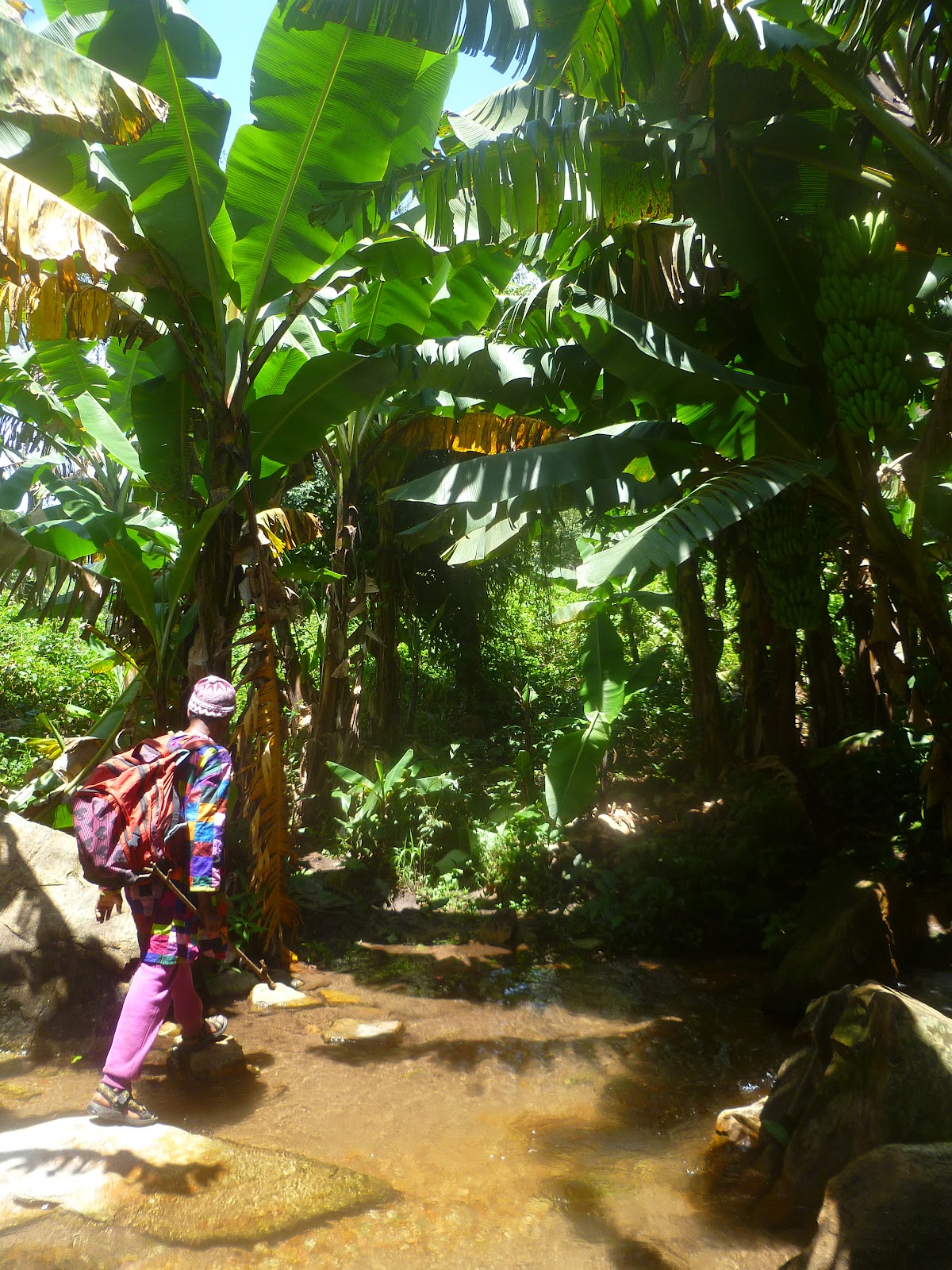
We spent a day and a half hiking and I saw some of the most beautiful things I’ve ever seen in my life. We took a 16 km hike down into the valley and back up through a waterfall on wooden ladders. We were very lucky as it was rainy season and thus there were waterfalls and streams aplenty yet it didn’t actually rain during the two days we were there. At one moment we were hiking down a waterfall practically inside the side of a mountain. I felt pretty hardcore…until I saw Guinean women hiking up the waterfall. Without shoes. With babies attached to their back. With buckets on their heads. All the trails we hiked exist not for tourist purposes, but because they’re routes that Guinean villagers use every day.

Here are some pictures, though they hardly capture the beauty:

Dalaba (on the way to Doucki)
Our living arrangements (bunk beds in a hut)

 Stunning views
waterfalls...and more waterfalls

 Jungle lagoon
Banana groves....and waterfalls
 Ladders...up the waterfalls
On top of the world

Saturday, September 15, 2012

Training...encore

PST (pre-service-training)

I spent two more weeks with the G-22 education trainees that are almost finished with their 3 month training in Dubreka. While I was there they started practice school which is a 3 week simulation of what teaching in Guinea is like. Students sign up for summer courses and the trainees prepare lessons, teach them, test the students and grade papers. It was a trip down memory lane for us PCV trainers. It's amazing how much we've learned in one year. Many of the same students at this year's practice school were also there last year and remembered us PCVs, which is pretty incredible since we only taught them for 3 weeks. It's an exciting time for the stagiaires as it marks the end of training and it's the time when they're finally doing what they came here to do. Insh'allah they'll all be swearing-in next week in Conakry. 

While in Dubreka I also got to spend some time with my former host family. My family couldn't believe that I have less than a year left of my service and told me that when I left they would come to the airport with me to say goodbye. The thought of leaving this place behind nearly brought me to tears...ey Allah

Here are a few pics from my time in Dubreka:
 Bike ride with other PCV trainers
 One of Dubreka's ports
 PCV Christina and I under "the big tree"
 PCVs Christina, Sarah and I at the other port of Dubreka
 Prof. Dante teaching about redox reactions in practice school
Prof. Carlos teaching about equivalent resistance
Prof. Ben teaching about line segments

Wednesday, September 5, 2012

Eid and Entamoeba

Entamoeba
Teachers who have first hand experience in the subject they teach makes the learning experience much better for students. That's why, the great teacher I am, I went out and got amoebic dysentery (it's an intestinal parasite)- so that next year I'll really know what I'm talking about. Well, actually it was a lot less deliberate than that. The good news is that I'm better now, and the best news is that next year in 12th grade biology I'll have a lot more to say when we talk about Entamoeba histolytica, though I'll probably spare them (and you) the finer details [You're welcome]. Anyway, because of this maladie I had to go to Conakry and subsequently didn't have enough time to get back to my village before going to Dubreka for training :( At least I got to celebrate the last few days of Ramadan and Eid in my village...


Eid-al-Fitr
 The end-of-Ramadan celebration took place last week, after a month of not eating or drinking during the day. I would have liked to fast the whole month, but I decided not to fast while I was with my parents, which left only about 6 days left out of the month. It is an incredible and fulfilling feeling to fast, knowing that more than a billion people are experiencing the exact same thing along with you. After sundown during Ramadan we broke our fast with rice porridge and sweet rice, followed by...rice and sauce of course. My host family doesn't really have the means to do anything special like buy juice or fruits or other foods which other families eat to break their fast.

Thankfully I was healthy enough in the morning of the Eid to partake in one of the most amazing spectacles I've ever witnessed. My host family invited me to pray at the mosque with them...and the rest of the village. I donned a beautiful white lace headscarf from my host mother and walked 25 minutes to the largest mosque at the edge of the village. I joined thousands of other women and men there, all dressed in their finest robes and complets. The mosque only held a few hundred people, so the rest of us were in front, back, to the side, along the road and encircling the whole area. I took my shoes off and joined my neighbor on her praying mat along with the other women. I had no idea what I was doing so I just followed everyone else's suit. I didn't feel weird or imposing because many Guineans had invited me to go and they wanted me to be a part of their community. The rest of the day was spent getting sali ma foed by very well dressed children, who, in wishing you a bonne fete, want money or candy in return. I like to think of it as a Guinean version of Halloween meets Christmas. The family also cooked a small feast, which included a very small portion  of meat from the cow that our neighbors had slaughtered the day before.

Wishing everyone a Bonne Fete! Sali Ma FoEid Mubarak!